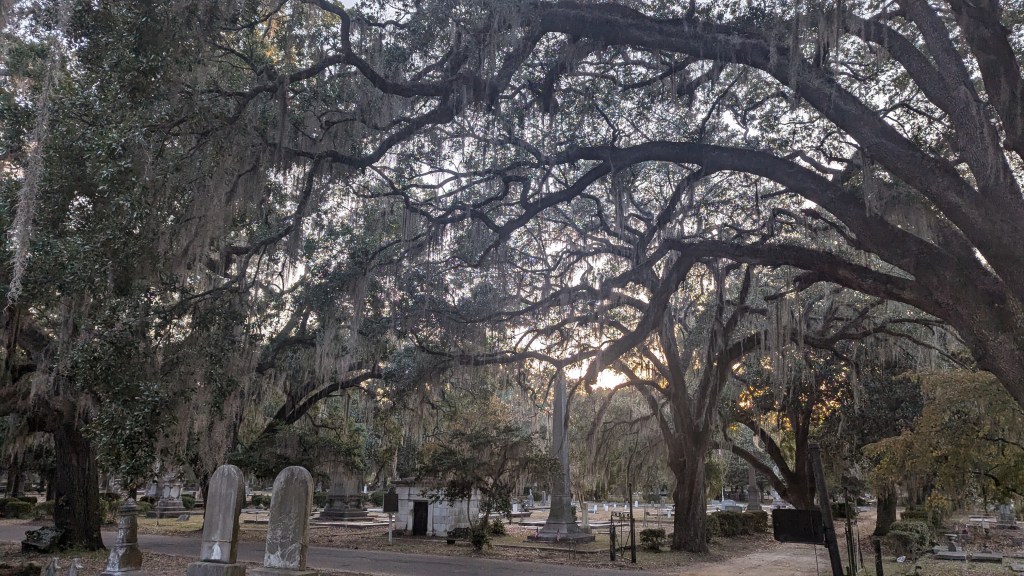

Note: this will be part of a series spotlighting residents of Old Live Oak Cemetery, inspired by the haunted history tours conducted by the historic preservation society. I will begin by looking at people who frequently appear on the tour, and then we’ll explore from there.
“John Haralson, John Haralson, you are a funny creature” — oh, Judge Haralson. You deserve better, I’m sure, than to be remembered by a bawdy poem lampooning your attempts to procure supplies during the War. Associate justice on the Alabama Supreme Court, President of the Southern Baptist Convention — his accomplishments were numerous, his name honored at his death. And now we stand at his grave and giggle about lifting skirts and shooting Yankees! Still, papers suggested that he had a good sense of humor, so perhaps he’s enjoying the joke himself.
The Judge was born in Lowndes County, one of Dallas County’s Blackbelt neighbors, a place still largely marked by agriculture. He attended the University of Alabama, graduating1 in 1857, earning both Bachelor and Masters degrees there, and completed his education studying law at the University of Louisiana. He began practicing law in 1853, and upon the outbreak of the War he became an agent for the Confederate government, particularly its Nitre and Mining Bureau2. It was in this capacity that (as the story goes) he issued a request for donations from the women of Selma — calling for “chamber lye”, or urine, with the idea using the niter to make gunpowder. He was promptly mocked by the provost agent, Thomas Wetmore, in a bit of verse, and supposedly wrote his own reply, and Alabama’s greatest living folk music historian, Bobby Horton, has been known to put the verses to music. All this said, I am not positive as to the exact source of the story, entertaining as it is: his request isn’t extant, only quotes thereof, so take it with a grain of salt. Nothing is said of his position with the Nitre Bureau in the obituaries which appeared in Selma, Montgomery, and Birmingham; they refer only to his practice of the law and subsequent career in politics, which would begin after the war despite an 1862 bid for the mayoral seat. 3
In 1876, he was appointed as the City Judge and presided over the City Court with what B.F. Riley, writing for the Birmingham Post-Herald, called “signal ability”, for sixteen years.4 This period of his life concluded when he was elected to the Alabama Supreme Court, there to serve for twelve years. Following his election, he moved to Montgomery and took up a residence on South Perry Street. Judging by the Montgomery papers, he became known and loved as a resident of the Gump: they saluted him as a man so upright and spotless that no unethical thought had ever entered his head. 5 Papers universally hailed his decisions as considerate and impartial, and his character as unimpeachable. In 1908, he announced that he would not be pursuing election, and thereby retired: the Advertiser praised his ‘unassailable record’. 6
A lifelong Baptist, he was chosen as the president of the Baptist state convention in 18737, and continued in that position for eighteen years, becoming the denomination’s most distinguished layman. In 1888, he was named president of the Southern Baptist Convention, and presided over the same for ten years, until he retired. Interestingly, his niece also served the Convention, in her capacity as secretary to the executive board — and did so for nearly fifty years. The Judge also served on the board of the Polytechnic Institute of Auburn, now known as Auburn University, and served on the board of the Alabama Baptist Education society.
His long life of public service came to an end in 1912, when he took ill for several months in the spring and summer8, and ultimately perished on July 11, at 11:15 a.m. His body was returned to lie “under the oaks” in Selma. . The Times-Journal was fulsome in its praise, referring to the Judge as “an educated, polished, and courteous gentleman”9 who was deeply interested in education and ranked among the foremost legal minds in the state. He was survived by his second wife, Lida McFadden of Greensboro, and two daughters, Carolyn and Willie Browning Stavley10. His wife of nearly fifty years would follow him in death some ten years later.
Created on February 26, 2024.
Last updated: March 1, 2024, to include a mention of his mayoral run.
- Coosa River News, July 26, 1912, 2. ↩︎
- Official biographical article, Alabama Judicial System. ↩︎
- John Hardee, Selma, Her Institutions and her Men (Selma, Alabama: Times Book and Job Off., 1879; reprinted, Spartanburg, SC: The Reprint Company, 1978), 79. ↩︎
- Birmingham Age-Herald, February 9, 1913. ↩︎
- Montgomery Advertiser, July 12, 1912. 1. ↩︎
- Montgomery Advertiser, February 28, 1908, 4. ↩︎
- Avery Hamilton Reid, Baptists in Alabama (Montgomery, AL: Paragon Press, 1967), 96. ↩︎
- Montgomery Advertiser, July 2, 1912. 6. ↩︎
- Selma Times-Journal, July 11, 1912. 1. ↩︎
- Montgomery Advertiser, April 9, 1905. 9. Took some doing to find that married daughter’s name, I will tell you. ↩︎

 Queen City Stories
Leave a comment