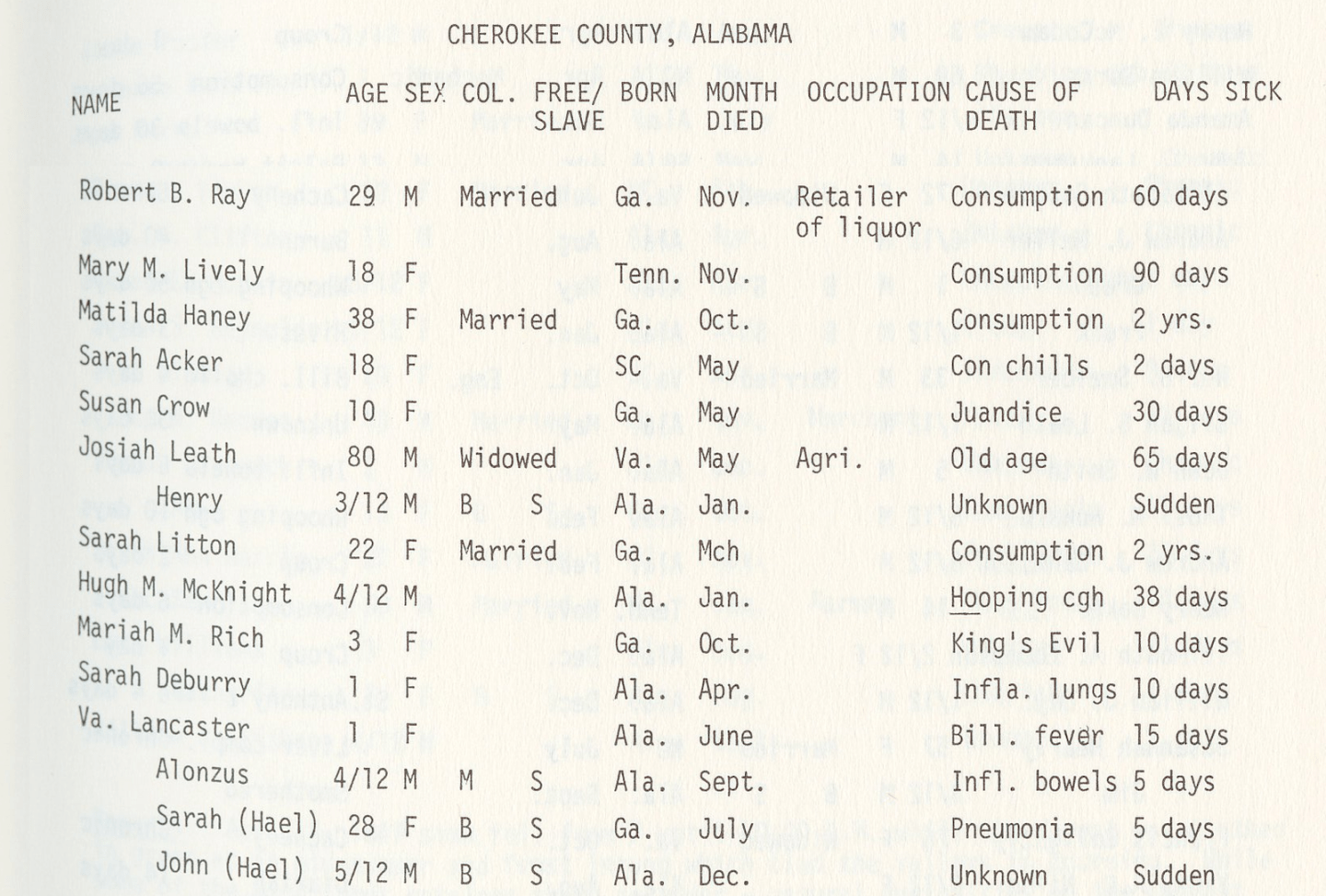
Years ago I stumbled a fascinating volume in the library’s local history collection: Alabama Mortality Schedule (1850, Seventh Census of the United States). It was as it described itself, a listing of people who perished, along with their age and the details of their death. I recognized many diseases like whooping cough and pleurisy, but scattered among the familiar were some….strange entries. I’d like to share a few with you on this All Hallows Eve.
(1)“St. Anthony’s Fire”. That sounds like an epic way to die, but it appears to be poisoning via wheat infected by fungi.
(2) “Milk Leg Fever“, which is the strangest way to describe a blood clot I can imagine.
(3) “Teething“. Teething? According to the University of Leeds, it was common in The Olden Days for people to attribute deaths by fever or such while a toddler was teething to the teething process itself. Oral health was serious back then: Red Gum, or gingivitis, is also listed as a cause of death. See? Flossing is important.
(4). “St. Vitus Dance“. A vernacular name for “Sydenham’s chorea”, an inflammatory response to strep. So named because its symptoms included bodily jerking, and people prayed for relief to St. Vitus, the patron saint of dancers. Must have been an old traditional name, since Alabama has never had a huge Catholic population.
(5) “Gunard Deply”. If you’ve ever done genealogical or historical research prior to the 19th century and dealt with handwritten sources, or typed transcriptions of handwritten source texts, you may appreciate the…er, creative variety of how names, etc were taken down by census takers and the like. “Diabeetus”, “New Monia”, and “Dysenterry” all appear in this book, for instance, indicating that Wilford Brimley may have been older than we knew. There’s no telling what Gunard Deply is, but ChatGPT guessed that it might’ve meant “General Debility”. If you think that’s too vague for an official Cause of Death, please know that this book also includes “Old Age”, “Complications”, and “Liquor” as causes.
(6) “Dirt Eater”. It is a ….thing…that some southerners, black and white, eat white clay. I’ve even seen bags of white dirt being sold in gas stations. One journalist who investigated this described the taste as “fresh rain on a hot day”. Evidently some people have a taste for it, just as some people can’t eat cilantro because it tastes like soap. (I am not one of these people, thanks be to God.) Strikingly, this is not a one off, but appears every so often. It’s a bit sad to have an insult hurled at one’s corpse as the official cause of death.
(7) “Complications”. Yeah, we’ve all had that that kind of weekend. Also see “Intemperance”. I’d possibly add “Mortification”, which often follows intemperance and its complications, but evidently in the 19th century that referred to necrosis or gangrene. (Relatedly: “Gravel” referred not to being stoned to death, but to kidney stones and related issues.)
(8) “Gen’l Derangement”. I’m sure there’s a story behind this one, as with “Spinster”.
(9) “Worms”. I’m guessing we’re talking tapeworms and hookworms, not Tremors type worms. According to the University of Arkansas, parents who believed their children had intestinal worms sometimes accidentally poisoned them with snake oil products — not the only case of someone dying of the cure. One strange entry in the book, “corrosive sublimate”, proved to be mercury poisoning as a treatment for syphilis.
(10) “The King’s Evil”. Tuberculosis in the lymph nodes! Back then TB is referred to as “consumption”, a handy fact if you ever want to impress a Civil War reenactor. The name comes from the King’s touch being the only supposed cure for this, again a sign of deep tradition.
Check out more strange deadly diseases over at CSI: Dixie’s “Graveyard of Old Diseases“! You can also check out mortality schedules for yourself over at Ancestry, and read about the background of their creation here.
While some of these names are amusing, and digging into what they meant proved to be both fun and stimulating, it was a stark reminder of how dangerous a place the 19th century frontier could be. There were sad stories I could glean from the data here, like an entire family who drowned together, or the constant spectre of infant mortality. Even so, there was humor to be found — from the absurd causes listed for some, to the census takers’ glimpses of humanity as they wrote in question marks behind listed causes they couldn’t understand.

 Queen City Stories
Leave a comment