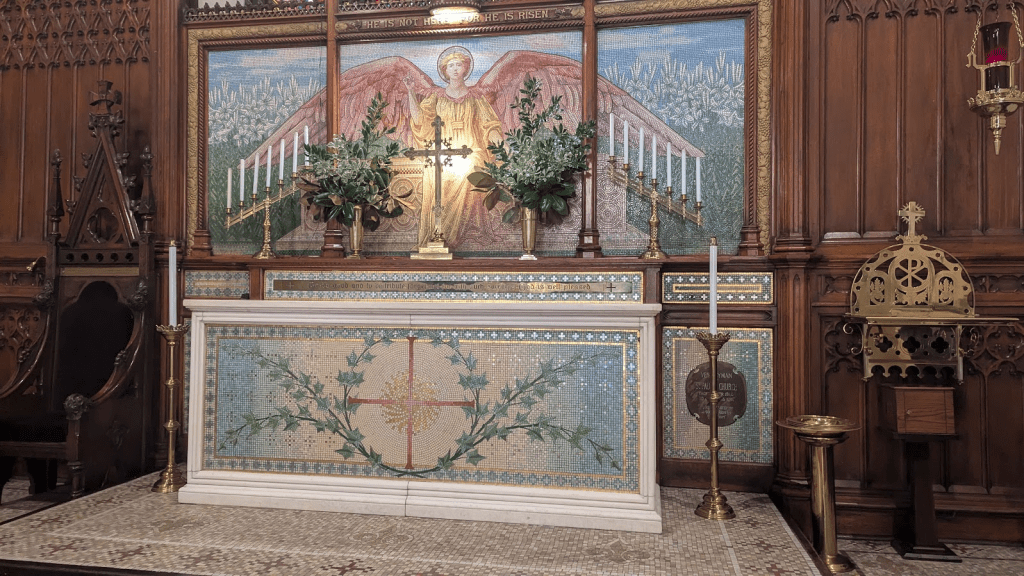
While researching the life of George O. Baker, a prominent Selmian with an impressively diverse occupational background — mining engineer, planter, etc — I stumbled upon a lengthy description of an altar donated to St. Paul’s Episcopal Church in his memory.
“THE BAKER MEMORIAL
A DESCRIPTION OF THE HANDSOME GIFT TO ST PAUL’S
“The Times takes pleasure in this issue in giving a description of the new Memorial Altar and Reredos, which will be used for the first time on this Easter Sunday in St. Paul’s Episcopal Church, Selma, Ala.
“This is the personal gift to the church of Mrs. George O. Baker. It is a fitting memorial to her husband, who was so well known, and is so kindly remembered by all.
“About a year ago, Mrs. Baker, after consultation with Dr. Barnwell in regard to this idea of a memorial, advised with the Messers. J&R. Lamb, of New York, in whose hands she placed the entire question of designing and executing a fitting and appropriate piece of work.
“Appreciating the artistic possibilities of this memorial, the Messrs. Lamb had the head of their designing department, Mr. Charles R. Lamb to visit Selma, and discuss with Mrs. Baker and Dr. Barnwell the details of the work.
“While here, he took the necessary measurements, made his preliminary suggestions, which he carried out in some important sketches, and submitted to Mrs. Baker.
“Mr. Lamb’s treatment of the idea was novel in method, but thoroughly artistic in result. It was to return to the older manner of the Italian churches in their decoration, and to use mosaic in brilliant colored enamel as the main feature of the decoration. The altar, therefore, became a combination of marble and mosaic. The white marble mensa, which, with its main constructive lines suitable frame the symbolic panels of the mosaic. In these, the Greek cross and the Ivy (the old symbol of affection) are deftly combined and so delicately graded in color, that the effect of the radiation of the light from the gloria of the cross over the entire field is secured.
“This altar rests upon a vitreous mosaic floor with fleur de lys ornamental details. This floor, in deep yellow and golden tones, is a fitting support for the chancel rail at the front of the sanctuary, and the reredos and retables rising on either side of the window high enough to surround the lower part window, while the main portion extends across the central — thus covering the entire wall below the window. The retable stands in front of this, being the full width of the window.
“The main feature of the reredos is the elaborate mosaic subject, The Angel of the Resurrection. This is divided into three openings, thus repeating the upright lines of the window tracery above the reredos. The tomb, and step upon which it stands, are continued through the entire composition while the seated figure of the angel, with uplifted hand, announces to the world the fact, “He is not here; He is risen,” occupies the entire central opening.
“The large extended wings of the angel, beautifully graded in color, continue through the entire panels, while the lilies (symbol of purity and innocence) are used with remarkably satisfactory results in filling the exterior part of the composition, and act as a frieze line behind the tomb throughout the entire work, while the green color of the leaves and the white lilies aid in supporting the more brilliant tones of the drapery and wings of the figure.
“The carved oak frame which surrounded this artistic mosaic has fruit for its chief ornamentation, and at the upper part an interlaced cresting of fleur de lys, which, in the center, just above the head of the angel, breaks forth into a CROWN form, just giving us a canopied effect above the figure, which adds to the dignity of the whole.
“The retable which supports this portion of the work, is elaborated by five panels of mosaic, the colors of which are so combined as to form the connecting link between the angel mosaic of the reredos and the symbolic mosaic of the marble altar. In the upper opening the text
“To do good and to distribute, forget not, for which sacrifices God is pleased”
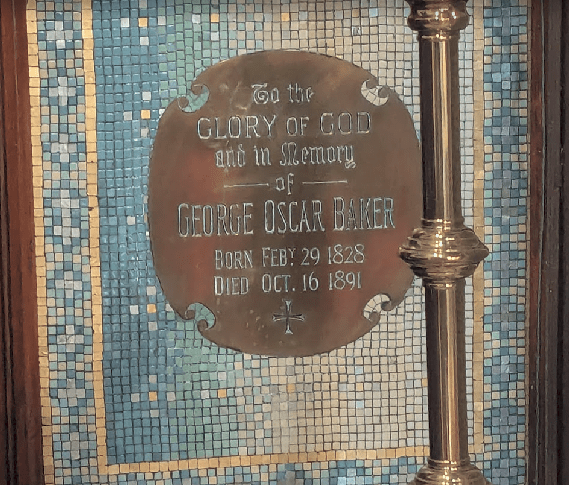
is chased in oxidized silver and inserted in the mosaic field, while in the panels on either side, oxidized silver shields receive the personal and historic inscriptions. On the left:
“To the glory of God and in the memory of GEORGE OSCAR BAKER. Born February 28,1828. Died October 16th, 1891.”
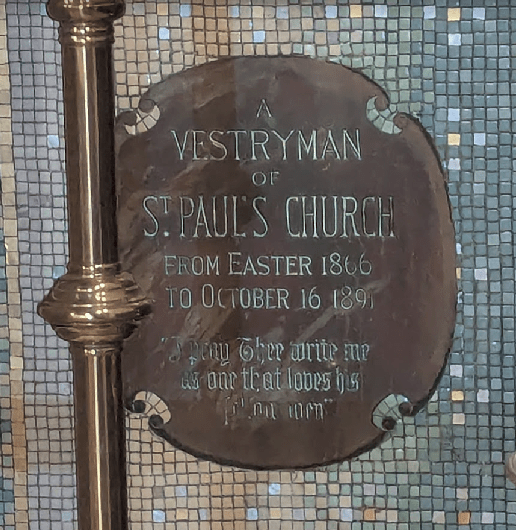
The shield on the right:
“Vestryman of St. Paul’s Church from Easter 1868 to October 15th, 1891.”
“I pray thee write me as one that loves his fellow man.”
“The description of the chancel, and the advantage of the enrichment of coloring on walls and ceiling of chancel and sanctuary, aid greatly the completed result. The eye is naturally led forward step by step, past the pulpit to the sanctuary, where it rests upon the altar in his combination of pure white marble, and delicate color of mosaic, and the figure of the angel above, whose message of the risen Lord is announced to the world.
“St. Paul’s church is to be congratulated upon this generous action on the part of Mrs. Baker, by which it has secured unquestionably the finest art work of its kind in any of our churches south, and we question if it has any equal in artistic result in any section of our country.
“It shows what can be secured when an intelligent artistic intention has been so designed as to contribute to one central result, the symbolic idea. The harmony of color leading from light to dark, from simple to ornate is the means used by which the attention of the observer is first attracted, and then held permanently.
“Those who have seen this work in place are universal in the opinion that it embodies a seriously considered religious idea as well as a permanent memorial of one who will be long remembered in Selma.”

 Queen City Stories
Leave a comment